 Sarah MacDonald: After I saw Tony, I wrote in my notes that the score seemed contemplative. I felt remorse there. Then I heard Matt Johnson say in an interview your score showed us Tony’s honest thoughts and reactions because, for most of the movie, he’s lying to people. I wonder if that’s accurate to you and can you tell me how you got there?
Jay McCarrol: You know, something I haven’t talked about before is that yes, I was obviously trying to represent where all of the needle drops in the soundtrack could not really give us a window into [Tony’s] true self. I was trying to put myself where this character was and—no matter how wild of a time he was having—to represent his inner turmoil. That adolescent uncertainty he was going through. He was wrestling with things. He talked about being angry during that time in his life.
Articles Page 1 of 3
View all the published/press articles here.
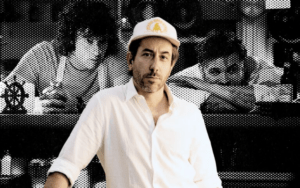
Against all that chaos, composer Jay McCarrol goes in the opposite direction. His minimal yet thunderous, bass-heavy piano score gives voice to the anger Bourdain refuses to express outright. Between punching walls and smashing bottles, it leaves the audience sitting in the frustration he’s constantly trying to outrun.
“We know that the storm of Anthony Bourdain is coming,” McCarrol says. “But this is just the beginning of him realizing he’s going to set sail in his life. It’s the first casting-off part.”
Paste Magazine: Let’s talk about Tony. How do you even begin to soundtrack Anthony Bourdain’s coming of age?
Jay McCarrol: Well, first, when I knew that we were doing a Bourdain movie and I was tasked to do the score, I knew I needed to just find a piece of music that I thought was fair and something that I could sign off on about the Bourdain that I have always known and loved. I’ve appreciated the type of man that he was and how he carried himself. He was very cool and dark and dignified, and I knew I needed a piece of music that had that in it. So, for a month or two, I played around on the piano and recorded a million different little voice memos on my iPhone, just trying to search for something that contained all those parts of him.
Nick: Tony begins his time at The Flagship by washing dishes. He’s low on the food chain, so to say. I’m curious to know what were the jobs you were doing where you had to cut your teeth before working your way into this industry?
Jay McCarroll: You know, I didn’t have particularly normal jobs when I was around that age. Like, I was a tennis instructor at a kids camp! In the winter, I learned how to snowboard pretty well, so I got certified and I would teach people snowboarding. But I was never like a hardcore coach. These were just summer jobs or winter jobs. Then I was a librarian, putting books back in the Dewey decimal system and sitting in complete quiet. I always made little mistakes and had embarrassing moments here and there. And I remember being 19 and having a short fuse, so I feel like I have a lot of empathy for anyone that age. You’re just going through a formative time where you’re still wrestling with inner angst and anger and frustration and whatever your inner demons are.
Nick: […]What I liked about Tony as a person is his acute observation of things which often leads to him learning something about cooking, or more often allowing him to build his lies even more. It’s almost like observation is his superpower. How has the art of observation helped when you do as editors?
Curt Lobb: For me, it’s all about being tuned into human faces and the little nuances that change in someone’s face, especially if they’re a really good actor and it’s not something overt. But, you need to be able to catch it, and if you catch it and put it on the screen, all humans can read it as well. It’s just about being the first one to make sure we’re bringing in all the best moments of nuance, I guess.
Robert Upchurch: I’ve noticed when I’m editing, it’ll be like late at night, I’m by myself looking at a screen in a dark room, and I’ve caught myself mimicking the faces that the actors are making, or responding without meaning to. But, I think that’s a good sign that you’re into it and feeling what the actors are giving, you know? That’s what is so great about editing, so much of it is just responding to what you’ve been given. And we were lucky with this movie and the performances we got.
‘Tony’ Editors Curt Lobb and Robert Upchurch Discuss Finding The Rhythm Of The Sharp Bourdain Biopic
Robert Upchurch: “Again, not in a super connective way, but Holes. I think we both love Holes.”
FilmSpeak: Good one.
Curt Lobb: “I maybe watched [Holes] more than any movie for like, a five-year window. I love Holes. It’s an ensemble thing too. Maybe that’s similar to Tony, you know? That one person, you gotta watch from their perspective, and there’s all these fun characters around them, helping form them into who they are, much like The Sandlot, also very fun.”

“People have expectations of me now that I’m an adult… but I don’t think anybody realizes that when I was young, I was an insecure, extremely scared boy and I wish I could show people that because in my own movies, I always portray myself as almost invincible,”
[Matt] continued, “I’m as invincible as a Clorox bottle when it comes to social situations, but that’s not the way I actually am. Here was an opportunity to show the way that I actually was, the way that Dominic [Sessa] actually was, and what we’re trying to maybe explore is that Anthony Bourdain also was not the invincible social adult that we all knew.”
 “With Tony, I wanted to figure out how Bourdain became who he was, and the discovery of Provincetown was as much a surprise to me as it was to him,” says Johnson, 40.
“It’s a coming-of-age story about somebody we all think we know, but nobody knows from this specific period of his life.
 Despite being only four days out from his wedding and just eight days before starting to shoot his next movie, Canadian director Matt Johnson looked decidedly relaxed last week.
He rolled up to Toronto’s Revue Cinema in a T-shirt and sweatpants to talk to CBC News about Tony, the buzzed-about biopic focused on the early years of world-renowned chef and TV personality Anthony Bourdain’s life.
Similar article from the Toronto Star.
McCarrol says the experience exposed him to a more regulated production environment, with stricter rules around unions, actors and what filmmakers can do on set.
“I think where the movie started to really come alive is when Matt returned to Canada, and all of us at Zapruder got to weigh in and watch it and discuss how to support certain sections, fix certain sections,” said McCarrol. “It’s a very collaborative process.”