NtB Media Page 1 of 6
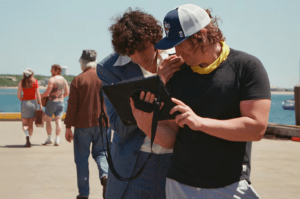
Rather than taking Bourdain’s version at face value, Johnson set out to discover what lay between the truth and the way it’s told. While working on the script, co-written with longtime collaborator Matthew Miller and based on a screenplay by Todd Bartels and Lou Howe, he spent two months immersed in local life in Provincetown, Massachusetts, where Bourdain spent three formative summers in the 1970s at what Kitchen Confidential calls a “honky-tonk fish restaurant.”
“The first-hand stories of the people who were there in the ’70s could never have been uncovered through reading,” Johnson says of what he learned from Provincetown residents. “Much of the dialogue and events in that kitchen were explained to me in detail by people who were there.” Of course, he’d known going in that history is often subjective. “Some people I spoke with gave an even more extreme account of his time there, while others accused it of being greatly exaggerated,” he says of the locals’ response to Bourdain’s lore.
 Sarah MacDonald: After I saw Tony, I wrote in my notes that the score seemed contemplative. I felt remorse there. Then I heard Matt Johnson say in an interview your score showed us Tony’s honest thoughts and reactions because, for most of the movie, he’s lying to people. I wonder if that’s accurate to you and can you tell me how you got there?
Jay McCarrol: You know, something I haven’t talked about before is that yes, I was obviously trying to represent where all of the needle drops in the soundtrack could not really give us a window into [Tony’s] true self. I was trying to put myself where this character was and—no matter how wild of a time he was having—to represent his inner turmoil. That adolescent uncertainty he was going through. He was wrestling with things. He talked about being angry during that time in his life.
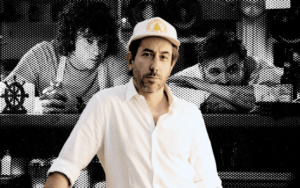
Against all that chaos, composer Jay McCarrol goes in the opposite direction. His minimal yet thunderous, bass-heavy piano score gives voice to the anger Bourdain refuses to express outright. Between punching walls and smashing bottles, it leaves the audience sitting in the frustration he’s constantly trying to outrun.
“We know that the storm of Anthony Bourdain is coming,” McCarrol says. “But this is just the beginning of him realizing he’s going to set sail in his life. It’s the first casting-off part.”
 If you’ve happened upon Liberty Village at any point in the past few weeks, though, you’ll likely have discovered that that’s not the case.
His next project, Journalism 101, inspired by the real-life case of a Toronto journalist-turned-drug smuggler, is deep into filming in the neighbourhood — which just so happens to be the exact neighbourhood where all the coke-fuelled drama went down in real life.
Paste Magazine: Let’s talk about Tony. How do you even begin to soundtrack Anthony Bourdain’s coming of age?
Jay McCarrol: Well, first, when I knew that we were doing a Bourdain movie and I was tasked to do the score, I knew I needed to just find a piece of music that I thought was fair and something that I could sign off on about the Bourdain that I have always known and loved. I’ve appreciated the type of man that he was and how he carried himself. He was very cool and dark and dignified, and I knew I needed a piece of music that had that in it. So, for a month or two, I played around on the piano and recorded a million different little voice memos on my iPhone, just trying to search for something that contained all those parts of him.
This interview was also published as individual clips on the CBC website.:
Canadian filmmaker Matt Johnson on working in the U.S.
How Dominic Sessa inspired Matt Johnson to make ‘Tony’
“Every single movie I’ve made has basically been about a bunch of young men making a movie,” said Johnson, this week’s guest on the Filmmaker Toolkit podcast. “Whether that’s the kitchen at the Flagship (‘Tony’), or it is the engineers at Research In Motion (‘BlackBerry’), or Matt and Owen in ‘The Dirties,’ or our CIA crew embedded at NASA in ‘Operation Avalanche,’ or Matt and Jay trying to get a show at the Rivoli (‘Nirvanna the Band the Show the Movie’), I’m constantly just reliving the feeling of being in film school, trying to figure out how to create myself and become an adult.”
This article is a companion piece to Why Do Most Biopics Stink? ‘Tony’ and ‘BlackBerry’ Director Matt Johnson Explains, taken from the interview in Indiewire’s Filmmaker Toolkit Podcast.
Interview with Matt starts an hour in. Video available for Spotify Premium members.
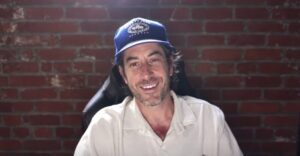
For composer Jay McCarrol, that meant resisting the temptation to musically foreshadow the larger-than-life figure waiting in Bourdain’s future. Instead, his score stays firmly inside the uncertainty, anger and darkness of the young man in front of us – the “first rumblings” of a storm still to come. Built from low upright piano, accordion, harmonium and textures that evoke “rust and worn wood,” McCarrol’s maritime-inflected score provides an intimate counterpoint to the film’s raucous humour and energetic needle drops.
Speaking with our Peter Gray, McCarrol discussed finding the musical language of a Bourdain who had yet to find his own voice, scoring the sudden optimism of a life-changing summer, and how years of friendship with Johnson have created a creative shorthand between director and composer.
 “I don’t know if there’s a craziest thing [to fame],” Johnson says, while he and Tony star Sessa, 23, discussed the movie with PEOPLE recently. “It’s certainly a major adjustment for me because I think, like Dom, like to live a pretty private life. I live in Toronto with my friends. I have, now with Dom, maybe what, like, eight friends in the world? So it has been taking a lot of getting used to.”